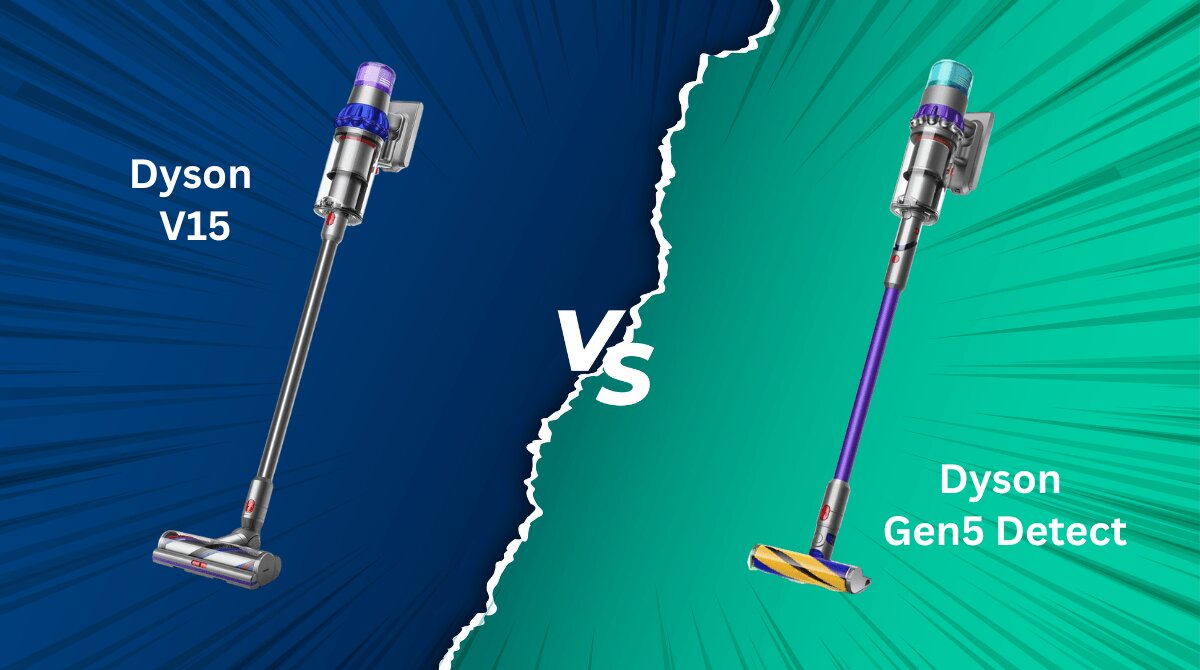

If you’re in the market for a full-sized cordless Dyson, you’re probably comparing the V15 and the Gen5 Detect. And honestly, it can be really confusing to figure out which one you should buy. On one hand, you’ve got the V15, which is the model that sounds like the V10, V11, and V12. It’s kind of like Dyson’s longtime flagship models. Then you’ve got the Gen5 Detect, which sounds a little bit strange. It’s more expensive and it’s not really clear how it fits in the lineup. They’re both expensive and they seem very similar on paper. So which one should you actually grab?
I’ve spent many hours testing both of these vacuums to gather data needed for this comparison, so let me break down every aspect of these two and help you make an informed choice.
Design and Build: Size Matters
Just visually, you could probably tell that the Gen5 Detect is a larger vacuum than the V15. The diameter of the motor area is larger. The battery is larger. The vacuum is noticeably heavier. The Gen5 Detect weighs around 3.5 kg (8 pounds and 15.7 ounces), while the V15 Detect comes in at about 3 kg. That’s roughly a 7-ounce difference, which might not sound like much, but every ounce counts for these products. The Gen5 is definitely a step up in heft, and you’ll feel that weight difference when you’re carrying it around for extended sessions.
If you have issues with hand strength or arthritis, one massive usability improvement stands out immediately: the power switch. The V15 uses a standard on-off trigger that you have to hold to run. The Gen5 Detect ditches the trigger entirely and replaces it with a button. So it’s a single touch on-off. If you don’t like holding your hand in that pressed position for extended periods of time, the Gen5 Detect is a really nice change of pace. Using the trigger for long stretches can be tiring, especially when cleaning upholstery where you must carry most of the weight with one arm. The push button switch lessens the strain on your arm and improves the vacuum’s ergonomics.
Dyson did add some small touches to deal with the weight. There’s padded grip area on the Gen5 that offers some protection to your hand, making it a bit more comfortable during extended sessions. The V15 doesn’t have that padding. I could argue you’re better off having less weight overall, but it’s a thoughtful gesture.
Both vacuums use the same horizontal dustbin configuration that Dyson started using in the V10, with the same capacity of around 0.77 liters. They both have the same lever placement that helps push debris out. There are no issues in most cases when emptying, except for really long strands of hair that tend to stick on the inner walls. If you need more capacity, the Gen5 Outsize gets you a massive 1.89 liter volume, but its bulky frame is harder to use above floors.
The Screens and Sensors
Both have that neat LCD display showing the Piezo sensor readout. It’s basically a real-time particle analyzer that shows how much of each debris size is being picked up. It’s genuinely cool to see, though there are some differences in the design.
The V15 Detect displays vertical bar graphs with the corresponding debris sizes. The Gen5 Detect displays horizontal bar graphs and includes text descriptions of what each size represents. Both screens are about the same size, and both show how much runtime is left in real time, so you know exactly when to plug in the charger. The Gen5 has a slightly more detailed settings menu, letting you adjust language, alerts, and particle count visibility. The V15 also lets you change motor sensitivity, which the Gen5 removed.
Both have fully sealed systems with rear-mounted filters. Here’s where things get noticeably different though. The Gen5 Detect uses a HEPA filter, while the V15 Detect uses a standard filter. Neither leaked during fog testing, so both do an excellent job of keeping debris inside the dustbin. Unfortunately, these filters aren’t interchangeable since the Gen5 Detect filter is larger and won’t fit the V15. Hopefully Dyson releases a HEPA-rated filter for the V15 at some point.

The Cleaner Heads
Both vacuums have floor-specific cleaner heads for hard floors and carpets. They both have slim roller nozzles with a bright green laser that flashes to highlight almost invisible dust particles. Here’s the good news: these nozzles are interchangeable, so you can use the Gen5 Detect fluffy laser nozzle on the V15 if you want something brighter.
One upgrade with the Gen5 Detect is it’s twice as bright as the V15 Detect, and that extra brightness actually helps reveal even more dust. The Gen5 Fluffy slim nozzle doesn’t have an on-off switch either, so it always stays on, while the V15 laser slim roller has a switch you can toggle. I don’t really see the need to turn it off, but some people might prefer having the option.
The standard cleaner heads on both look similar, with a chunky brush, adjustable gates, and combs. But I noticed the Gen5 Detect nozzle vibrating a bit more, which helps it agitate carpet better. It seems to have a better seal too, since the brush stops spinning if the gates are closed all the way. With the Gen5, you have to move the lever to the middle setting so the brush doesn’t stop. This didn’t happen with the V15 at any point during testing. The Gen5 Detect is easier to push on carpet with the gates halfway open than the V15 Detect with the gates closed. And it had enough power to pick up 100% of sand during deep cleaning experiments, so that’s a huge plus.
One thing worth noting: the Gen5 Detect has fewer tools included. It comes with only three attachments aside from the floor nozzles, which is three fewer than the V15 Detect. But Dyson introduced a new two-in-one crevice tool with the Gen5 that’s neatly tucked inside the wand. This is actually thoughtful design. You can clean upholstery on the fly without carrying extra attachments around.
Power and Performance: Where It Gets Real
Here’s the big question I was most curious about: how much more power does the Gen5 Detect actually have over the V15? Dyson claims the new Hyperdymium motor is their most powerful to date, so I tested both pretty thoroughly for suction and airflow.
The results didn’t disappoint during the suction tests. The Gen5 got 28 inches of water lift in the unsealed test (which represents normal usage) and 75 inches of water lift in the sealed test. Those figures represent a 22 and 14 percent increase over the V15, respectively. That’s legitimate power advantage.
But here’s where it gets interesting. That improved suction didn’t translate to better airflow across the board. The V15 was actually better in most tests, except for the max setting with the extension tube. I was hoping for a jump similar to what the V15 had over the V11, but that didn’t happen. It was honestly a bit of a disappointment.
The real proof is in the cleaning tests though. Both were excellent across the board, picking up in the high 99s or 100 percent in all tests. This shows the all around efficiency of the nozzles. Both are excellent options if you need a cordless vacuum that can pick up dirt on hard floors and carpets equally well.
Cleaning hair is another strong suit for both vacuums, getting high percentages on both surfaces. The Gen5 Detect has a slight edge on hard floors since it got more hair in the extended tests. Both were excellent on carpet, getting 100% in all tests. Add in the torque screw tool’s ability to pick up long hair without wrapping on the brush, and both the Gen5 and V15 Detect are great options for long hair. So cleaning performance shouldn’t be a deciding factor between these two.
Runtime: The Practical Reality
The V15 Detect is good for 60 minutes, which is a very long time on eco mode. No complaints there. The Gen5 Detect claims 70 minutes max. Here’s the thing though: if you’re running it on auto mode, where the suction adjusts automatically, you’re not hitting that full runtime.
In real-world testing, the Gen5 Detect exceeded 46 minutes on hard floors and 22 minutes on carpet in auto mode, which is better than the V15 results. But I was expecting a bigger jump than that, honestly. The V15 was pulling around 30 minutes on auto, so the difference is noticeable but not huge. The Gen5 Detect only lasts a little over 80 minutes on the lowest setting, which is about 4 minutes more than the V15.
The thing is, the Gen5 has a visibly larger battery, but it has a lower 2500 milliamp rating than the V15’s 3600 milliamp rating. That might explain why it’s not as dominant as you’d think. If you need extended runtime, you can purchase an extra battery to extend your time, or grab the Gen5 Outsize that comes with two batteries.
Noise: The Elephant in the Room
If you thought the V15 is noisy, then wait till you hear how loud the Gen5 Detect is. The Gen5 was over 70 decibels in all tests and nearly 90 decibels using the digital motorbar nozzle in max setting. That’s legitimately loud. The V15 is a little bit louder than the Gen5 Detect and has a slightly higher pitch, but the Gen5 gets louder at max power.
The good news is the auto setting is enough for most tasks on carpet, unless you need to deep clean spot areas. And on eco mode, the Gen5 Detect is very quiet and very pleasant to use. So if you’re using your vacuum at night, the Gen5 handles it better on lower settings.
Price: The Bottom Line
This is probably the deciding factor for most people. The V15 Detect currently costs around $849.99, though you can find deals bringing it down to $600-750. The Gen5 Detect starts at $1,049.99. That’s a couple hundred dollar gap that matters.
You’re getting like 90% of the vacuum for maybe 60% of the cost with the V15. The value clearly goes to the V15. If you just want a high-end, maxed out Dyson for the long haul, then the Gen5 Detect is your move. But for most people’s budgets, the V15 makes serious sense.
The Final Verdict
So is it time to upgrade to the Dyson Gen5 Detect or just save a few hundred and go with the V15 Detect? The answer depends on your budget and what features you’ll actually prioritize. Do you need the brighter fluffy optic nozzle? Or the longer runtime in auto mode? Or the higher suction for deep cleaning carpets without fully closing the gates? Or do you want more tools out of the box?
If I’m being honest, I generally prefer the Gen5 Detect. It’s just a better vacuum. The push button is genuinely nice, the quietness on eco mode is impressive, and that extra power is real. But the weight does bother me, and that price tag is significant.
For most people, the V15 Detect is the smarter buy. It’s a genuinely excellent vacuum that handles everything you throw at it, the laser works great, and the performance is identical to the Gen5 in everyday cleaning. You’re not losing much, and you’re keeping more money in your pocket.
I don’t think you go wrong with either of these. They’re both very good vacuums. Just depends on whether that extra performance is worth the extra cash to you. For most households, the V15 is absolutely sufficient. But if you’re a heavy vacuumer or you really care about having the latest tech, the Gen5 Detect delivers on that promise.